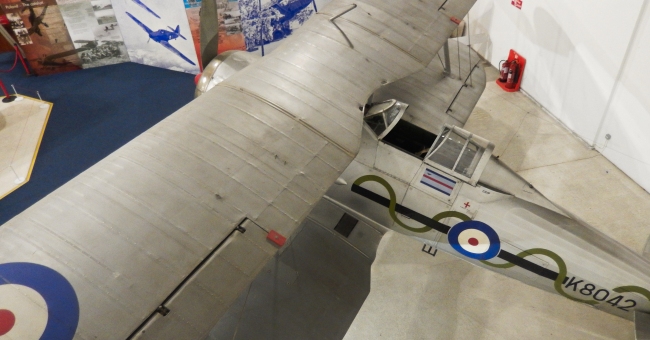
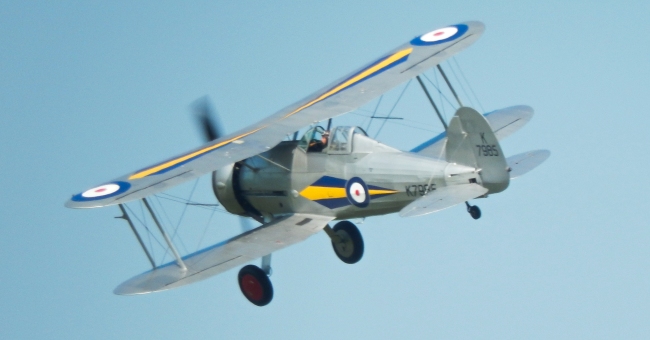
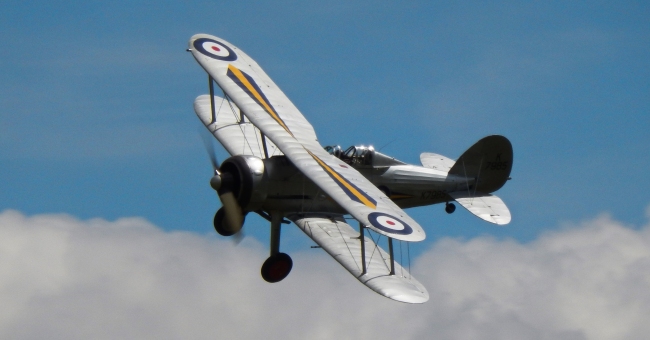
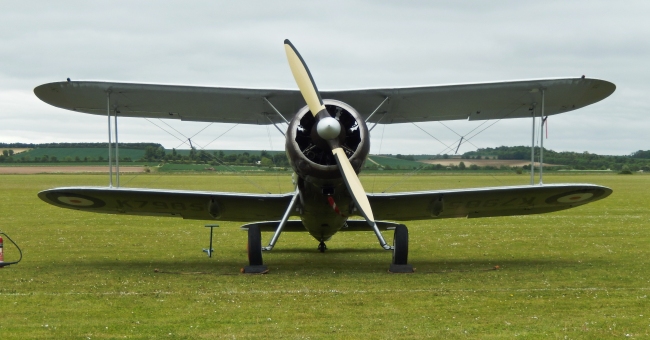
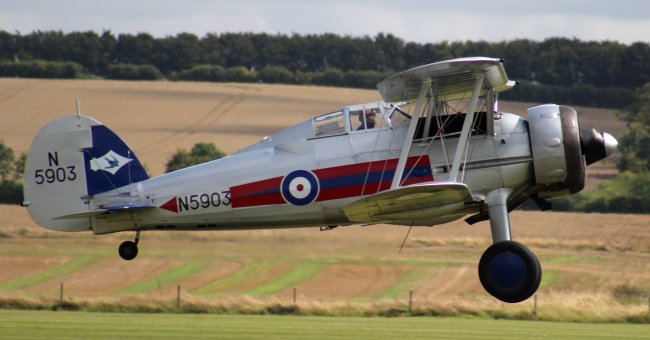
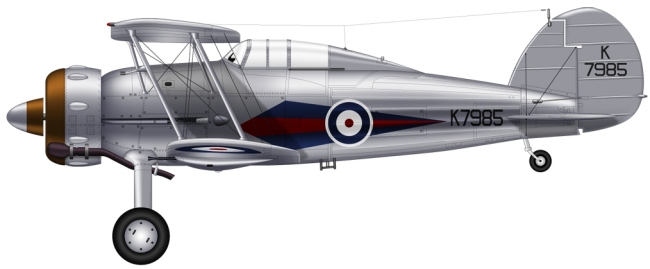
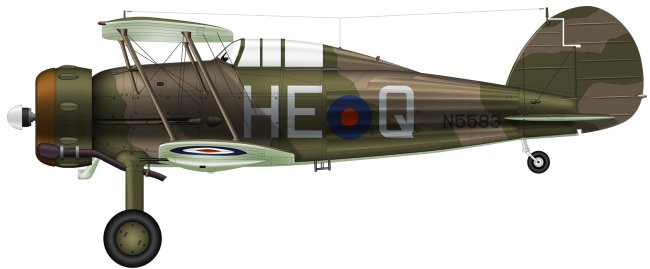
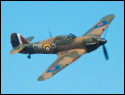
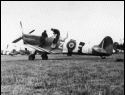
The last biplane fighter used by the Royal Air Force, the Gladiator entered service in 1937, but two years later the type was obsolete and being phased out of service. With a number still
in service at the outbreak of the Second World War, the Gloster Gladiator would be in action during the French and Norwegian campaigns in 1940. The Finnish Air Force also used the aircraft
during the Winter War and Continuation War.
In 1931 the Air Ministry was looking for a replacement for the Bristol Bulldog, despite already ordering the
Gloster Gauntlet, which led to Specification F.7/30 being issued on the 1st October 1931. This called for a fighter with a minimum
speed of 250 mph and armament consisting of four machine-guns. Despite a number of submissions, no suitable aircraft was forthcoming, so a further order for Gauntlets was placed.
Henry Folland, Gloster's chief designer, took the Gauntlet design and examined it in detail to see how much its performance could be improved. As a result of the design study, the wings
were changed to single bay units, with the main spars strengthened and internally sprung landing gear installed. Although studies showed the promise of monoplane fighters, the biplane design of
the Gauntlet was kept for the new aircraft. With the reduction in drag as a result of the changes, a 10–15 mph improvement in top speed was expected. The prototype, designated SS.73, and with test
pilot Gerry Sayer at the controls, flew for the first time on the 12th September 1934, and a top speed of 236 mph was recorded using the Bristol Mercury IV engine. In
November 1934 the installation of a Bristol Mercury VIS engine saw the top speed increase to 242 mph.
After submitting the new design to the Air Ministry during June 1935, Specification F.14/35 was issued specifically for the aircraft. However, this required changes, including an enclosed
cockpit and the 830-hp Bristol Mercury IX engine being fitted. Three months later an order for 23 aircraft was placed. The 1st July 1935 saw the aircraft's name of Gladiator being announced.
Early Gladiator Mk Is had armament of two Vickers guns, mounted within the fuselage, and two Lewis guns, under the wings. Later examples had a universal armament mounting under each wing which
would accept either Vickers, Lewis or Colt-Browning machine guns.
The Gladiator Mk I was powered by the 840-hp Bristol Mercury IX engine and had a top speed of 253 mph, a range of 428 miles and a service ceiling of 32,800 ft. Armament was four 0.303-in machine-guns.
The aircraft entered service with the reformed No. 72 Squadron at RAF Tangmere on the 22nd February 1937, followed in March 1937 by No. 3 Squadron at RAF Kenley, who were equipped with Bristol Bulldog Mk IIAs.
The only other variant was the Gladiator Mk II, powered by the 856-hp Bristol Mercury VIIIA engine, which had specifically been fitted with gun synchronisation gear for the type, its top speed was 257 mph,
range 440 miles whilst its service ceiling was 33,500 ft. Armament consisted of four 0.303-in machine-guns.
At the outbreak of the Second World War (1939 – 1945) the Gladiator was being phased out of Royal Air Force service, but a few squadrons were still equipped with the type. These included No. 607 Squadron,
who had scored the first aerial victory by a Gladiator in RAF service on the 17th October 1939 when a Dornier Do 18 of 2./KuFlGr 606 was shot down, and No. 615 Squadron. Both of these squadrons would be sent to
France on the 15th November 1939 to provide air support for the British Expeditionary Force. By the time the Battle of France (10th May 1940 - 25th June 1940) began, both squadrons were beginning to replace their
Gladiators with Hawker Hurricanes.
No. 263 Squadron, which reformed with the Gladiator on the 2nd October 1939 at RAF Filton, would be sent to Norway. Arriving on the 24th April 1940 in Oppland, Norway. Within the first couple of days
they claimed two Heinkel He 111s, before returning to the UK a few days later. They returned to Norway on the 21st May 1940, but with the
situation in Norway deteriorating, No. 263 Squadron would be evacuated back to the UK via HMS Glorious (77), which on the 8th June 1940 was sunk by the German Battleships Gneisenau and Scharnhorst.
Pilots from the squadron were among the over 1,200 people to die as a result of the sinking.
A flight of Gladiator Mk IIs would see service during the Battle of Britain (10th July 1940 - 31st October 1940) as
part of the Fighter Flight, RAF Sumburgh, later No. 247 Squadron, which reformed on the 1st August 1940. First over the Shetland Islands before moving to RAF Roborough as part of No. 10 Group,
Fighter Command. The 28th October 1940 would see the squadron engage in combat against the Luftwaffe for the first time, when a Heinkel He 111 was intercepted, without result, over Plymouth by a Gladiator flown by Flying Officer
Richard Winter. The Gladiators frontline service in the UK came to an and in 1941 when No. 247 Squadron were fully equipped with the Hurricane. The Gladiator also saw action in the Mediterranean and saw combat against the
Fiat CR.32 and Fiat CR.42 biplanes of the Italian Air Force.
The Gladiator would also be used by a number of Air Forces world wide. The Chinese Nationalist Air Force operated 36 during the Second Sino-Japanese War (1937-1945), and it was whilst serving with the Chinese Nationalist Air Force that the type first
saw combat and scored its first aerial victory. This occurred on the 24th February 1938 over a Mitsubishi A5M. The Finnish Air Force used the Gladiator in the Winter War (1939 - 1940) and Continuation War (1941 - 1944)
against the Soviet Union. Other operators of the Gladiator included the air forces of Belgium, Greece and Norway, who had a number in service when Germany invaded the country on the 9th April 1940 along
with Denmark as part of Operation Weserübung.
When production of the Gladiator ceased, a total of 648 had been built, and it would stay in service with the Royal Air Force after their frontline service had ended where, until 1944, they were used for communications, liaison and metrological use.
A naval variant known as the Sea Gladiator was produced with 60 built and around 40 converted Gladiator Mk IIs. These were fitted with an arrestor hook, catapult points and dinghy storage.