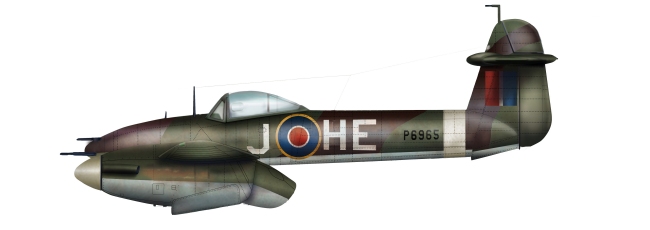
Quick facts - First flight: 11th October 1938 | Entered service: 6th July 1940 | Total built: 116
The twin-engined Whirlwind showed potential with its performance and cannon armament. However, the aircraft suffered due to production delays and reliability issues with its Rolls-Royce Peregrine engine, which led to the engine
being cancelled. Only two squadrons would be equipped with the Westland Whirlwind before it was phased out of frontline service in 1943.
Issued by the Air Ministry in 1935, Specification F.37/35 called for a single-seater fighter with armament of four cannons. Westland's design team, led by William Petter, worked on the
company's submission, the Whirlwind, with an order for two prototypes placed in February 1937.
With Harald Penrose at the controls the prototype flew for the first time on the 11th October 1938, followed by an order for 200 aircraft in January 1939. No. 25 Squadron would receive the first two
production aircraft, which they undertook trials with in May and June 1940.
The Whirlwind Mk I, which would be the first twin-engined fighter of the Royal Air Force, was powered by a pair of 885-hp Rolls-Royce Peregrine I engines giving the aircraft a top speed of 387 mph, range of 800 miles and a
service ceiling of 30,300 ft. Armament was four 20mm cannons and 1,000lb bombs. No. 263 Squadron based at RAF Grangemouth received their first production version on the 6th July 1940. As they began the task of eliminating
bugs in both the airframe and Rolls-Royce Peregrine engine.
No. 263 Squadron used the Whirlwind alongside their Hawker Hurricanes and after moving to RAF Exeter
became operational with the aircraft on the 7th December 1940 when they flew a patrol over Plymouth. They would have their remaining Hurricanes replaced, and on the 20th January 1941 would become the first squadron to
only operate the Whirlwind. The squadron would claim its first success on the 8th February 1941 when an Arado Ar 196 was shot down.
Due to a shortage of engines, deliveries of the Whirlwind were slow with the Royal Air Force receiving only eight of the type by the close of 1940, in fact only one other squadron would be equipped
with the Whirlwind. This was No. 137 Squadron which was formed on the 20th September 1941 at RAF Charmy Down.
Despite the positive performance and armament of the aircraft, its dogfighting abilities at higher altitude was called into question, and it could only be used at a limited number of
airfields due to its high landing speed, leading to a second order that had been placed for 200 more aircraft to be cancelled and the initial contract for 200 aircraft cut to just 112.
By the end of 1943 the Whirlwind had been replaced by the Hawker Hurricane which re-equipped No. 137 Squadron with Hawker Typhoons
re-equipping No. 263 Squadron.
During its service with the Royal Air Force the Whirlwind undertook escort duties and ground attack sorties over Europe. It would be No. 263 Squadron who undertook the Whirlwind's final operational
sortie on the 29th November 1943.
January 1942 would see the last of the 116 Westland Whirlwinds leave the production line.
Technical Details
| Whirlwind Mk I |
387 mph |
800 miles |
30,300 ft |
four 20mm cannons
1,000lb bombs |
|
See This Aircraft
Read profiles on over 90 aircraft that flew between 1930 and 1945, with technical details for each variant.
 |
|
|
Our articles cover a range of subjects, including the history of invasion stripes and the story of a German Spitfire.
 |
|
|
Our timeline covers the day-to-day action that took place during the battle, in the air and on the ground.
 |
|
|
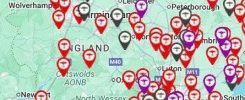
With 217 locations across the UK on our map, it's easy to discover the aviation history on your doorstep.
 |
|