|
 |
|
|
 |
 |
|
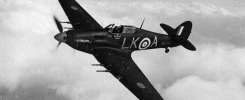
Forming the backbone of Fighter Command during the early stages of the Second World War, the Hurricane played a vital role during the Battle of Britain. Serving in almost every theatre of war, the aircraft would fulfil a variety of roles. One of the more successful variants was the Hawker Hurricane Mk IID 'Tank Buster', which earnt the nickname 'Flying Can Openers'.
In 1933 Sydney Camm, Hawker's chief designer, discussed with the Air Ministry the prospect of a monoplane fighter. This aircraft was to be based on the Hawker Fury biplane and powered by a Rolls-Royce Goshawk engine. However, the Air Ministry rejected the design. So Camm and his team went away and set about improving the aircraft's design. This aircraft, known as the Fury monoplane, would be based around the 1,000-hp Rolls-Royce PV.12 engine, which would become the Merlin. Impressed with this redesign the Air Ministry placed an order for a prototype on the 21st February 1935 around Specification F.36/34.
The first flight of the prototype Hurricane, powered by a 1,025-hp Rolls-Royce Merlin 'C' engine, would take place at Brooklands on the 6th November 1935 with George Bulman, test pilot at Hawker, at the controls. The prototype then arrived at the Aeroplane and Armament Experimental Establishment on the 5th March 1936, with an order for 600 aircraft placed on the 3rd June 1936, and on the 26th June 1936 the aircraft was officially named the Hurricane. One of the conditions for the order was for the aircraft to be installed with a Rolls-Royce Merlin II engine. It wouldn't be until the 12th October 1937, 16 months after the order was placed, that the first Hurricane Mk I production aircraft flew.
The Hurricane Mk I, powered by either the Rolls-Royce Merlin II or III engine, had a top speed of 316 mph, a range of 525 miles with a service ceiling of 33,200 ft. Armament consisted of eight 0.303-in machine-guns. When No. 111 Squadron, based at RAF Northolt, received their first Hurricane on the 15th December 1937 the type became the first Royal Air Force fighter to have eight machine-guns as well as the first to fly faster than 300 mph in level flight. The squadron was fully converted by the end of January 1938 and by the end of the year around 200 aircraft had been delivered, with a further 1,000 ordered in November 1938. When war broke out on the 3rd September 1939 the RAF had 18 Hurricane squadrons available.
A few days after the outbreak of hostilities four Hurricane squadrons, Nos. 1, 73, 85 and 87, were sent to France to support the British Expeditionary Force. October 1939 saw two of these squadrons, Nos. 1 and 73, become part of the Advanced Air Striking Force. Little action was seen during the early months of the Second World War (1939 - 1945) in what was known as the 'Phoney War'. Although the Hurricane achieved two firsts during this period. On the 21st October 1939 it achieved the first successful radar interception of the war by Fighter Command. This saw No. 46 Squadron, RAF Digby shoot down six of nine Heinkel He 115s intercepted.
After the German invasion of France and the low countries on the 10th May 1940 a further four Hurricane squadrons would be sent to France. When the Battle of France (10th May 1940 - 25th June 1940) ended, a total of 386 Hawker Hurricanes had been lost in the 46 days since the 10th May 1940, many on the ground. A sole Hurricane squadron, No. 46, was sent to Norway during May 1940, losing all of its aircraft as they made their way back to Britain, when on the 8th June 1940 whilst aboard HMS Glorious (77), it was sunk, with only two of the ten pilots surviving.

July 1940 saw the Battle of Britain (10th July 1940 - 31st October 1940) begin and during the battle the Hurricane showed its worth as even with other aircraft and ground defences combined it shot down more enemy aircraft. It was also a Hurricane pilot, Flight Lieutenant James Brindley Nicolson of No. 249 Squadron, who was awarded Fighter Command's only Victoria Cross of the war. During the same period a tropical version of the type appeared with a number of changes, including a larger coolant radiator, and these would be sent to help with the defence of Malta, with the first four arriving on the 21st June 1940 to fly alongside the Gloster Sea Gladiators there.
The Rolls-Royce Merlin XX engined Hurricane Mk II would be the next to enter service, the prototype having made its maiden flight on the 11th June 1940, with a top speed of 340 mph, a range of 460 miles and a service ceiling of 36,000 ft and armament of eight 0.303-in machine-guns. These began to enter service during November 1940. Development of this variant saw the Hurricane Mk IIB appear with an increase in armament to twelve 0.303-in machine-guns and able to carry 1,000lb bombs. These made their operational debut on the 30th October 1941, when two from No. 607 Squadron based at RAF Manston attacked a transformer station.
The other two main Hurricane Mk II sub-variants were the Hurricane Mk IIC, whose armament consisted of four 20mm cannons and able to carry 1,000lb bombs. This would be the most produced variant and were nicknamed 'Hurribomber'. It would be the Hurricane Mk IID 'Tank Buster' that would give the type a new lease of life. The prototype made its first flight during December 1941 with a new wing designed to enable a 40mm Vickers 'S' anti-tank gun under each wing and a 0.303-in machine-gun to help with aiming. It would be No. 6 Squadron, on the 6th June 1942, who used the type operationally for the first time and it was to prove successful against German and Japanese armour.
The next planned variant was the Hurricane Mk III, which was to be powered by a Packard Merlin engine, but this never went past the prototype stage, so the next variant to enter service was the Hurricane Mk IV. Powered by either a 1,620-hp Rolls-Royce Merlin 24 or 27 engine enabling a top speed of 330 mph with a range of 495 miles and a service ceiling of 32,100 ft. Armament was two 40mm Vickers 'S' guns and two 0.303-in machine guns with either 1,000lb bombs or rocket projectiles. It was to be a Hurricane Mk IV that would use air-to-ground rocket projectiles operationally for the first time on the 2nd September 1943. This variant was mainly used in the Mediterranean and Far East.
Powered by a 1,645-hp Rolls-Royce Merlin 32 engine and fitted with a Rotol four bladed propeller three Hurricane Mk Vs would be produced with two of these being Hurricane Mk IVs converted to Hurricane Mk V standard.The first one flew on the 3rd April 1943 but with no real improvement in performance of the type it never progressed further than these three aircraft.

The Hurricane's time in frontline service with the Royal Air Force in Europe started to come to an end in 1944 as they were replaced by the Hawker Typhoon. The type would remain in service elsewhere with the last operational Hawker Hurricane sortie undertaken by a Royal Air Force squadron done by No. 6 Squadron on the 13th January 1947. This was followed two days later on the 15th January 1947 when the same squadron had their remaining Hurricane Mk IVs replaced by the Hawker Tempest. Bringing an end to the types twelve year RAF service. The Hurricane also saw service with the Soviet Union, who would receive 2,952 as part of Lend-Lease, whilst the South African Air Force operated a number of squadrons. Finland would also use a handful during the Winter War (1939 – 1940) with the Portuguese Air Force the last to retire their Hurricanes which they did in 1954.
A naval version of the Hurricane, known as the Sea Hurricane, was also produced and these would operate from catapult aircraft merchantmen, merchant aircraft carriers and aircraft carriers. One of the more unusual aircraft considered was the Hillson FH.40 Slip-Wing Hurricane. This saw an additional wing added to the aircraft giving it the appearance of a biplane. The idea was to produce extra lift on take-off and provide extra fuel with the wing being jettisoned when no longer needed. This never got past the trials stage.
During the Second World War a number of two-seater Hurricanes were also produced after modifications in the field to help train Soviet Union pilots on the type. The United States modified three to serve as two-seater trainers. There were only two official two-seaters built by Hawker, known as Hurricane Mk T.IIC, with the first one flying on the 27th September 1946.
Two further uses saw a Hurricane Mk I used by No. 527 Squadron, who were formed at RAF Castle Camps on the 15th June 1943 to perform radar calibration duties, painted in a red-orange colour for use in this role. Whilst the following year saw No. 1697 (ADLS) Flight formed as part of Transport Command. These would have their underwing tanks converted to hold mail.
Hurricane Mk IIC known as The Last of the Many was the final Hurricane of 14,583 to be built, including 1,451 in Canada by the Canadian Car and Foundry Company, when production ended in July 1944.

| Top Speed | Range | Service Ceiling | Armament | |||
|---|---|---|---|---|---|---|
| Hurricane Mk I | 316 mph | 525 miles | 33,200 ft | eight 0.303-in machine-guns | 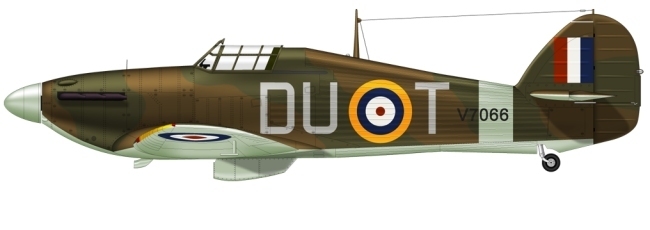 |
|
| Hurricane Mk II | 340 mph | 460 miles | 36,000 ft | eight 0.303-in machine-guns | 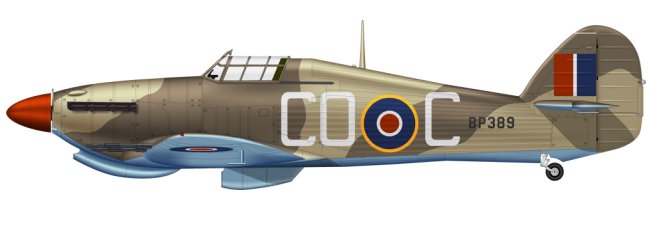 |
|
| Hurricane Mk III | Powered by the Packard Merlin but none produced under this designation. | |||||
| Hurricane Mk IV | 330 mph | 495 miles | 32,100 ft | two 40mm Vickers 'S' guns two 0.303-in machine guns and either 1,000lb bombs or rocket projectiles |
||
| Hurricane Mk V | Three aircraft, two of which were converted Hurricane Mk IVs, with a 1,645-hp Rolls-Royce Merlin 32 engine. | |||||
| Hurricane Mk X | Built in Canada and powered by the 1,300-hp Packard Merlin 28. | |||||
| Hurricane Mk XII | Built in Canada and powered by the 1,300-hp Packard Merlin 29. | |||||
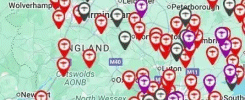
| Location | ||
|---|---|---|
| Hurricane Mk I | Battle of Britain Memorial | |
| Hurricane Mk IIC x2 | Battle of Britain Memorial Flight Visitor Centre | |
| Hurricane Mk IIA | Brooklands Museum | |
| Hurricane Mk I | Eden Camp | |
| Hurricane Mk I x 2 | Imperial War Museum, Duxford | |
| Hurricane Mk IIB | ||
| Hurricane Mk ? | (F) | Jet Age Museum |
| Hurricane Mk I | Kent Battle of Britain Museum | |
| Hurricane Mk IIC | RAF Manston Spitfire & Hurricane Memorial Museum | |
| Hurricane Mk I | Royal Air Force Museum, London | |
| Hurricane Mk IIC | Royal Air Force Museum, Midlands | |
| Hurricane Mk I | Science Museum | |
| Hurricane Mk XIIA | Shuttleworth | |
| Hurricane Mk I | Spitfire Visitor Centre | |
| Hurricane Mk I | Tangmere Military Aviation Museum | |
| Hurricane Mk IV | Thinktank - Birmingham Science Museum | |
| Hurricane Mk ? | We'll Meet Again WW2 Homefront Museum | |
| Hurricane Mk I | Yorkshire Air Museum |
What's on Classic Warbirds |
|
|
|
|
|