|
 |
|
|
 |
 |
|
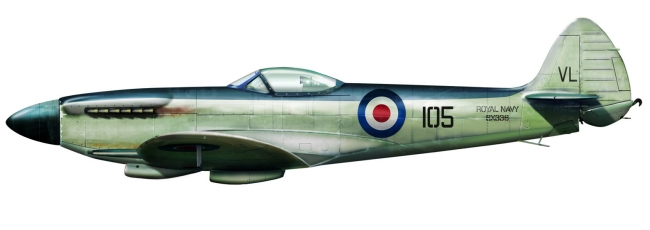
The Seafire was the naval version of the Spitfire and entered service with the Fleet Air Arm during June 1942, where it would serve as a frontline aircraft until 1951. During the Second World War the type would take part in Operation Torch. The Korean War saw No. 800 Naval Air Squadron use the Supermarine Seafire operating from HMS Triumph. Other users of the type included the French Aeronavale and Royal Canadian Navy.
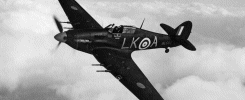
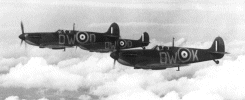
The idea for a naval version of the Supermarine Spitfire originated during 1938, but it wouldn't be until November 1939 when a Spitfire was tested to assess whether the type could be used aboard an aircraft carrier. However, the need for Spitfires within the Royal Air Force led to the Fleet Air Arm ordering the Fairey Fulmar as their new fighter to compliment the Blackburn Roc and Gloster Sea Gladiator. After the Spitfire excelled during the Battle of Britain (10th July 1940 - 31st October 1940), the Admiralty would again show interest in the aircraft for use aboard its carriers, and again it would have to wait. However, they were able to secure the use of a navalised Hawker Hurricane known as the Sea Hurricane.
Eventually in October 1941 permission for a Sea Spitfire was granted, with the first prototype flying on the 7th January 1942. Three days later on the 10th January 1942 it performed its first deck landing when it touched down on HMS Illustrious (87). Although the modified Spitfire made a number of deck landings, take-offs and catapult launches these were done under favourable conditions, therefore, providing little warning of the problems the Seafire would encounter in operational conditions. Forty eight Spitfire Mk Vs would be converted to Seafire Mk IBs with the first one flying on the 23rd March 1942 and entering service on the 15th June 1942 when No. 807 Naval Air Squadron received the first examples. Powered by the 1,470-hp Rolls-Royce Merlin 45 the top speed of the aircraft was 365 mph with a range of 460 miles and a service ceiling of 36,900 ft. Armament was two 20mm cannons and four 0.303-in machine-guns.
Converting the Spitfire required an arrestor hook, catapult spools and slinging lugs, which were reinforced, on both sides of the fuselage, as well as naval avionics to be added. It would be Air Service Training at Hamble who would convert a number of Spitfires whilst Supermarine modified a number on the production line and brand new Seafires were built by Cunliffe-Owen Aircraft. The major hindrance for the Seafire was the fact that during its development the Spitfire was never considered to be used aboard an aircraft carrier. Two of the major issues with the type were its poor forward view and inability to carry more fuel internally.
The Seafire Mk IIC was built as a naval aircraft from the very start and on the 23rd May 1942 the first production aircraft flew. The Seafire Mk IIC was powered by the 1,645-hp Rolls-Royce Merlin 32 engine which gave the aircraft a top speed of 342 mph, range of 460 miles with a service ceiling of 37,500 ft. Alongside its armament of two 20mm cannons and four 0.303-in machine-guns it could carry 500lb of bombs. The first Seafire Mk IICs entered service during June 1942 with No. 807 Naval Air Squadron and these along with Seafires which No. 801 Naval Air Squadron received in September 1942 would serve aboard HMS Furious (47) until February 1943. During this time they participated in the Allied invasion of North Africa, known as Operation Torch, which began on the 8th November 1942. A total of five Seafire squadrons would be used, destroying a total of nine Vichy France aircraft, five in the air and four on the ground. One Seafire Mk IIC would be sent to the United States for tests at the Naval Airtest Centre.
Seafire operations continued and the following September they were tasked with protecting the fleet during the Allied invasion of Italy at Salerno, known as Operation Avalanche on the 9th September 1943. Although forty four were lost, just two were a result of combat. Most had suffered accidents, so many in fact that they had exhausted the spare propellers stock aboard HMS Hunter (D80), the only action available was to cut six inches off each blade of the damaged propeller. This was to become standard practice as it proved an effective remedy. Despite its problems the Seafire would be the fastest fighter afloat during a ten month period from October 1942 until August 1943 when the A6M5 Zero and F6F-3 Hellcat started to enter service.
A modified Seafire Mk IIC provided the basis for the Seafire Mk III prototype which made its maiden flight on the 9th November 1942 with the Fleet Air Arm receiving their first example on the 8th June 1943 and when they entered service on the 27th November 1943 with No. 894 Naval Air Squadron they would be the first Seafires to have manually folding wings with two folds, one before the armament and the other allowing the wing tip to fold downwards, the Seafire Mk III made handling of the aircraft much easier and it could be transported using carrier lifts. Powered by the 1,585-hp Rolls-Royce Merlin 55M engine, its top speed was 352 mph, range 465 miles with a service ceiling of 33,800 ft. Armament consisted of two 20mm cannons and four 0.303-in machine-guns. Bomb load was 500lb.
The Seafire Mk III played a role in Operation Overlord, more commonly known as D-Day, on the 6th June 1944 and was involved in the invasion of Southern France, Operation Dragoon, on the 15th August 1944 and eight Seafire Mk IIIs would take part, on the 15th August 1945, in one of the last dogfights of the Second World War (1939 – 1945) when twelve Japanese aircraft, four Mitsubishi J2M Raidens and eight A6M Zeros came up against Nos. 887 and 894 Naval Air Squadrons who lost a single Seafire but shot down seven Zeros in the battle above Tokyo Bay, Japan.
The 31st August 1943 saw the Air Ministry issue Specification N.4/43 for six Seafires, three prototypes and three pre-production aircraft to be powered by the Rolls-Royce Griffon engine, this was a natural change to match the engine change with the Spitfire, which led to the Seafire Mk XV. Fitted with the 1,850-hp Rolls-Royce Griffon VI engine its top speed was 369 mph, range 524 miles with a service ceiling of 34,600 ft. Armament was two 20mm cannons, four 0.303-in machine-guns and 500lb of bombs. The Seafire Mk XV also had a new 'sting' type arrestor hook. These entered service during May 1945 with No. 802 Naval Air Squadron at RNAS Arbroath.
Development of the type continued and the Seafire Mk XVII featured a clear-view bubble canopy and an increase in fuel capacity, however this would not see service during the Second World War. Powered by the 1,950-hp Rolls-Royce Griffon VI engine the aircraft had a top speed of 373 mph, range of 697 miles and a service ceiling of 34,600 ft. Armament consisted of two 20mm cannons, four 0.303-in machine-guns and either 500lb bombs or rocket projectiles.
Next in the Seafire lineage was the 2,035-hp Rolls-Royce Griffon 61 engined Seafire Mk 45. This had a top speed of 450 mph, range of 400 miles and a service ceiling of 42,400 ft. Armament was four 20mm cannons with a bomb load of 500lb. As the Seafire Mk 45 would not equip frontline squadrons they lacked the folding wings from previous variants. This was followed by the Seafire Mk 46 which was powered by the 2,300-hp Rolls-Royce Griffon 87 engine and had contra-rotating propellers. Its top speed was 435 mph, range 435 miles with a service ceiling of 41,000 ft. Armament consisted of four 20mm cannons and either 500lb bombs or rocket projectiles.
The Seafire Mk 47 would be the last variant and the first to feature wing folding which was power operated. Flying for the first time on the 25th April 1946. Powered by the 2,350-hp Rolls-Royce Griffon 87 engine it had a top speed of 452 mph, range of 405 miles with a service ceiling of 43,100 ft. Armament was four 20mm cannons with either 1,500lb bombs or rocket projectiles. No. 804 Naval Air Squadron were the first to be equipped with the aircraft when they took delivery of thirteen during January 1948.
The Seafire F. Mk 47 would see action during the Korean War (1950 – 1953) with No. 800 Naval Air Squadron who operated from HMS Triumph (R16). They were involved in their first action on the 3rd July 1950 and would spend nearly three months on operations until the 25th September 1950, during this period they flew 360 sorties. When the squadron returned to Britain they received the Supermarine Attacker to replace their Seafire F. Mk 47s in 1951, the Seafires frontline service was over. The Seafire was eventually retired from Fleet Air Arm service when No. 764 Naval Air Squadron was disbanded on the 23rd November 1954.
The type would also serve with the Royal Canadian Navy and French Aeronavale and a total of 2,646 would be built by the time the last Seafire rolled of the production line, a Seafire Mk 47, on the 28th January 1949.

| Top Speed | Range | Service Ceiling | Armament | ||
|---|---|---|---|---|---|
| Seafire Mk I | 365 mph | 460 miles | 36,900 ft | two 20mm cannons four 0.303-in machine-guns |
|
| Seafire Mk II | 342 mph | 460 miles | 37,500 ft | two 20mm cannons four 0.303-in machine-guns 500lb bombs |
|
| Seafire Mk III | 352 mph | 465 miles | 33,800 ft | two 20mm cannons four 0.303-in machine-guns 500lb bombs |
|
| Seafire Mk XV | 369 mph | 524 miles | 34,600 ft | two 20mm cannons four 0.303-in machine-guns 500lb bombs |
|
| Seafire Mk XVII | 373 mph | 697 miles | 34,600 ft | two 20mm cannons four 0.303-in machine-guns and either 500lb bombs or rocket projectiles |
 |
| Seafire Mk 45 | 450 mph | 400 miles | 42,400 ft | four 20mm cannons 500lb bombs |
|
| Seafire Mk 46 | 435 mph | 435 miles | 41,000 ft | four 20mm cannons and either 500lb bombs or rocket projectiles |
|
| Seafire Mk 47 | 452 mph | 405 miles | 43,100 ft | four 20mm cannons and either 1,500lb bombs or rocket projectiles |
| Location | ||
|---|---|---|
| Seafire Mk F.17 | Fleet Air Arm Museum |
What's on Classic Warbirds |
|
|
|
|
|