On the 6th June 1944, Operation Overlord, also known as D-Day, took place. Over 11,500 Allied aircraft took part in the operation, which saw the liberation of Western Europe from German occupation begin. This article covers
some of the aircraft types used and different operations carried out, that made up the 14,674 sorties undertaken on this crucial day, which saw 127 aircraft lost.
Part of the 2nd Tactical Air Force, No. 143 Wing, Royal Canadian Air Force was made up of three squadrons, Nos. 438, 439 and 440 Squadron, RCAF,
all based at RAF Hurn and equipped with the Hawker Typhoon. Serving in the
air alert role, operating three squadrons at a time, with each squadron assigned one of the beaches that the British and Canadian forces were landing at. No. 428 Squadron was to attack targets around Gold Beach, No. 439 Squadron
around Juno Beach and No. 440 Squadron around Sword Beach. It was timed, so that the aircraft would arrive as the first landing craft were arriving at the beaches.
Operating from RAF Manston, Fairey Albacores of No. 415 Squadron, Royal Canadian Air
Force, equipped with Air-to-Surface Vessel Mk II radar and a bomb load of six 250lb bombs, performed a number of anti-shipping sorties
around the French coast during the early morning and late evening, with no aircraft lost. During one patrol, three E-boats were bombed by the squadron off Cap Gris-Nez, France, claiming at least one sunk.
Flying from RAF Tarrant Rushton, six Handley Page Halifax
glider tugs, three each from No. 298 and No. 644 Squadron, towing one Airspeed Horsa glider each, which carried 'D' Company 2nd Battalion
Oxfordshire and Buckinghamshire Light Infantry and sappers from the 249 Field Company, Royal Engineers. Their objective would be to capture bridges over the Caen Canal and River Orne, France, with three gliders assigned to each
bridge. When they were fifteen miles from the bridges, the Halifax released the gliders, three landed just 100 yards from their target bridge, Bennuville, over the Caen Canal, with two of the other three Horsas landing near
their target, the Ranville Bridge over the River Orne. The mission was a success, with both bridges captured intact, leading to the bridge over the River Orne being renamed after the Horsa.
No. 418 Squadron, Royal Canadian Air Force, based at RAF Holmsley South, flying de Havilland Mosquitos,
would carry out a number of flower operations. These targeted enemy aircraft trying to take-off or reach altitude, this meant the enemy aircraft had to protect their airfields, instead of attacking Allied bombers. During these
sorties, the squadron would claim at least five aircraft, including four Junkers Ju 52s.
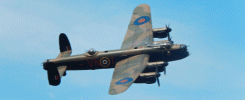
Operation Taxable would involve the Avro Lancasters of No. 617 Squadron, based at
RAF Woodhall Spa, mimicking an invasion force making its way to Cap d'Antifer, France. This would see eight aircraft at a time, operating in four
rows of two, fly precise circuits at a height of 3,000 ft, dropping 'Window', which were strips of aluminium foil, to give the appearance on German radar that an invasion fleet was on its way. Starting thirty miles off the
French coast, during the course of the early morning, in conjunction with eighteen boats, made up from Royal Navy Harbour Defence motor launches and Royal Air Force Air
Sea Rescue launches, they flew their circuits over the English Channel until dawn, when they were just a few miles off the French coast and the operation concluded.
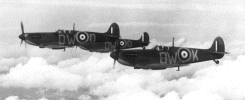
Flying from RNAS Lee-on-Solent, Cruiser Scouting Squadron 7, United States Navy were equipped with Supermarine Spitfires,
fitted with external fuel tanks and still in their Royal Air Force colours. They would be spotters for ships of the Western Naval Task Force, who would provide support to the US First Army as they landed at Utah and Omaha Beaches.
The aircraft would operate in pairs, one being the spotter, normally flying at a altitude of 4,000 ft – 8,000 ft, watching where the ships fire fell, which included the USS Nevada (BB-36) and USS Texas (BB-35),
and providing corrections if necessary. The other aircraft, 2,000 ft above, would be watching for enemy aircraft. The squadron would lose one pilot, Lieutenant Richard Barclay, whose aircraft was hit by flak.
In the afternoon, Fairey Swordfish from No. 819 Naval Air Squadron, who were on loan to Coastal Command, took-off from RAF Manston. Their
role was to lay a smokescreen around the Strait of Dover to cover convoy ETP1. This was made up of a number of ships, including three troop ships and a pair of hospital carriers, which were on their way to the invasion beaches.
Over 1,000 Douglas Dakotas, flying from multiple airfields, including RAF Blakehill Farm and
RAF Broadwell, would tow gliders or drop paratroopers. This included the US 82nd Airborne Division and US 101st Airborne Division, who landed behind
Utah Beach and had a number of targets, including taking control of the town of Sainte-Mere-Eglise, France, and the British 6th Airborne Division, who landed behind Sword Beach, with one of their objectives being the
destruction of the Merville Gun Battery. By the end of the day, Dakotas help transport over 23,000 troops taking part in the airborne operations.
Based at RAF Davidstow Moor, No. 144 Squadron and No. 404 Squadron, Royal Canadian Air Force, equipped with Bristol Beaufighters,
made up the Davidstow Moor Strike Wing, No. 19 Group. Thirty one aircraft, comprising seventeen from No. 144 Squadron and fourteen from No. 404 Squadron, RCAF, took-off in the early evening, with ten de Havilland Mosquitos
from No. 248 Squadron as escort, they were tasked with locating and attacking three German destroyers. These were ZH1, Z24 and Z32, part of the 8th Destroyer Flotilla, that had been reported making
their way north from the Gironde estuary, France. After a couple of hours flying, they came across their targets, South West of the Belle lle, France. As a result of their attack, all three destroyers were damaged and had to
undergo repairs. Four Beaufighters were damaged during the attack, one crew had to ditch in the English Channel, but were later rescued.
Twenty two Short Stirlings, comprised from No. 90 Squadron, flying from RAF Tuddenham, and No. 149 Squadron, flying from
RAF Methwold, would take part in Operation Titanic. They would drop a number of dummy
paratroopers, which were nicknamed 'Ruperts', over different parts of France, including near Yvetot and Yerville. At 3 ft tall the 'Ruperts' were designed to ignite and self-destruct once they landed, although some would
replicate the sound of gunfire and explosions, then self-destruct. Two aircraft, both from No. 149 Squadron, failed to return, and of the eighteen airmen, fifteen died and three ended up prisoners of war.
|
The Luftwaffe would fly 319 sorties on D-Day in response to the Allied invasion. These included 2./ZG 1, who sent twelve Junkers Ju 88s to attack the
invasion forces, and they made their way to Caen, France. No. 485 Squadron, Royal New Zealand Air Force and No. 349 (Belgian) Squadron, No. 135 Wing, 2nd
Tactical Air Force, Spitfires were on patrol in the area and intercepted the Ju 88s, claiming four aircraft. Also in action were Focke-Wulf Fw 190s of III./SG 4,
taking-off at around 17:15, four aircraft made their way to Saint-Aubin, France, in the Juno Beach landing area, to target landing craft. As a result of their attack, they claimed two landing craft and all returned to their
airfield around an hour later.
|