|
 |
|
|
 |
 |
|
The Spitfire was one of the best fighter aircraft to see service during the Second World War, and just over 20,000 were built of Reginald Joseph Mitchell's design. Best known for its role in the Battle of Britain during its wartime career the Supermarine Spitfire would serve in theatres of war all over the world. In 1957, 19 years after it entered service with the Royal Air Force, the aircraft was retired.
The Spitfire had its roots in the Supermarine Type 224 which the company submitted to meet Air Ministry Specification F.7/30, issued on the 1st October 1931. The aircraft's top speed was 225 mph, 25 mph slower than the top speed of 250 mph which the specification called for and it would be the Gloster Gladiator that would be ordered into production. Despite the disappointing performance of the aircraft, the experience and data gathered would prove beneficial for Supermarine's next design.
Supermarine submitted its new design, the Supermarine Type 300, produced under the leadership of Reginald Joseph Mitchell and powered by the Rolls-Royce Goshawk engine. Despite the improvements no order was forthcoming from the Air Ministry. However, a change of engine to the Rolls-Royce PV.12, later to become the Merlin, saw a prototype ordered on the 1st December 1934 with Specification F.37/34 issued on the 3rd January 1935 for the prototype to be built. Three months later in April 1935 the Air Ministry issued Specification F.10/35 and the Type 300 would be developed to meet this.
The prototype Spitfire was powered by a 990-hp Rolls-Royce Merlin 'C' engine and Captain Joseph Summers piloted the aircraft on its maiden flight on the 5th March 1936. The 26th March 1936 saw the Spitfire prototype arrive at the Aeroplane and Armament Experimental Establishment at Martlesham Heath and 310 Spitfire Mk Is were ordered on the 3rd June 1936 with the 28th July 1936 seeing the aircraft officially named the Spitfire. Sadly the following year on the 11th June 1937 Reginald Joseph Mitchell passed away, with development of the Spitfire given to Joe Smith.
The maiden Spitfire Mk I first flew on the 14th May 1938 and was powered by the 1,030-hp Rolls-Royce Merlin II engine, giving it a top speed of 364 mph, range of 425 miles and a service ceiling of 34,500 ft. Initially only half of the intended eight 0.303-in machine-guns were fitted due to supply shortages and when Spitfires with eight machine-guns did appear they were designated as Spitfire Mk IAs. A small number of Spitfire Mk IBs with two 20mm cannons appeared in 1940 for operational trials, but as the cannon kept jamming as a result of having to be fitted on their side due to the Spitfire's thin wing, which led to cartridge cases not dispersing properly in certain situations, these were withdrawn.
The Spitfire Mk I entered service when No. 19 Squadron, based at RAF Duxford, received the first on the 4th August 1938. A further eight squadrons would be equipped with the type by the time the Second World War (1939 – 1945) started in September 1939. The next month would see the Spitfire score its first victories, when on the 16th October 1939, two Junkers Ju 88 A-1s of I./KG 30 were shot down over the Firth of Forth, one by No. 602 Squadron and the other by No. 603 Squadron, these were the first German aircraft shot down over Britain in the Second World War. The following month saw a Spitfire PR Mk IA deployed to France followed by a Spitfire PR Mk IB, but these would serve in the reconnaissance role only, with the Spitfire PR Mk IA performing the first successful reconnaissance on the 22nd November 1939, photographing Eupen-Elsenborn, Belgium.

It wouldn't be until the 12th May 1940 that a fighter version of the Spitfire would operate over Europe when No. 66 Squadron, based at RAF Duxford were in action over the Netherlands alongside No. 264 Squadron Boulton Paul Defiants. Its first engagement against the Messerschmitt Bf 109 occurred eleven days later on the 23rd May 1940 when Nos. 54 and 74 Squadron engaged Bf 109Es of I./JG 27. As the Battle of Britain (10th July 1940 - 31st October 1940) loomed, a total of nineteen squadrons were now equipped with the Spitfire.
Serving as a prototype of the Spitfire Mk II, a Spitfire Mk I was fitted with a 1,150-hp Rolls-Royce Merlin XII engine, with the 24th September 1939 seeing the first flight. The production Spitfire Mk II was powered by the 1,175-hp Rolls-Royce Merlin XII which enabled a top speed of 370 mph, range of 500 miles and a service ceiling of 32,500 ft. Armament was eight 0.303-in machine-guns and this made its operational debut on the 31st August 1940 with No. 611 Squadron based at RAF Digby. Some Spitfire Mk IIBs had the same two 20mm cannon armament of the Spitfire Mk IB, with the addition of blisters in the wings to help overcome the jamming issues. When Fighter Command started their Rhubarbs over Europe on the 20th December 1940, it was with No. 66 Squadron and a pair of their Spitfire Mk IIs, which attacked Le Touquet Airfield in France. Spitfires would also take part in the first Royal Air Force Circus operation on the 10th January 1941. They would be part of a force of fighters escorting six Bristol Blenheims of No. 114 Squadron when they attacked an ammunition dump at Foret de Guines, France.
The Spitfire Mk III was the next in the lineage but would never progress past a single prototype. This intended version would have a number of improvements such as clipped wings, by 2 ft on each wing, stronger undercarriage, retractable tail wheel and a type 'C' universal wing able to take different armament and a internal laminated bulletproof windscreen. The prototype was a converted Spitfire Mk I which was powered by a 1,240-hp Rolls-Royce Merlin XX and this flew on the 15th March 1940. Although an order was placed for the Spitfire Mk III it would later be cancelled due to a shortage of available Rolls-Royce Merlin XX engines. Despite not entering service a number of the features from the Spitfire Mk III would appear on later Spitfires.
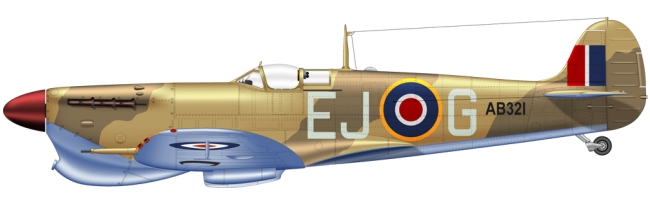
The next version was the Spitfire Mk V, with the 26th December 1940 seeing the prototype make its first flight. This was intended to be a stopgap measure but would go on to be the most produced and used Spitfire variant. Powered by the 1,470-hp Rolls-Royce Merlin 45 engine which gave it a top speed of 375 mph, a range of 470 miles and a service ceiling of 35,500 ft. Armament was two 20mm cannons and four 0.303-in machine-guns. The Spitfire Mk V began to enter service during February 1941 with No. 92 Squadron based at RAF Biggin Hill being the first to receive the type. The Spitfire Mk VB would be the first of the type to serve overseas as fighters, when Malta received fifteen which were flown from HMS Eagle (94) on the 7th March 1942. Tropicalised Spitfire Mk VBs which had an air intake filter under the nose were sent to the Middle East during May 1942. With the arrival of No. 54 Squadron based at RAAF Station Darwin in January 1943 they became the first to use Spitfire Mk Vs in the Pacific. 1943 also saw some Spitfire LF Mk Vs appear with clipped wings and these were powered by a 1,585-hp Rolls-Royce Merlin 45M engine for low altitude operations.
During December 1939 the use of a Rolls-Royce Griffon to power the Spitfire was conceived, but engine development delays meant it would be a further two years before a prototype could be ordered. A tailored Specification F.4/41 was written for the aircraft which was given the designation Spitfire Mk IV, and two prototypes were ordered on the 26th May 1941, and on the 23rd August 1941 750 were ordered. Only one prototype was built in the end and this was powered by a 1,445-hp Rolls-Royce Griffon RG 25M IIB engine and had a top speed of 423 mph and was to be armed with up to six 20mm cannons, and this flew on the 27th November 1941 for the first time with Jeffrey Quill at the controls. In the end the aircraft would not enter production with the 750 Spitfire Mk IVs ordered being built as either Spitfire Mk VB or Spitfire Mk VCs instead. The Spitfire Mk IV prototype would be renamed to Spitfire Mk XX, to avoid confusion with a Spitfire photo reconnaissance version which was renamed to Spitfire Mk IV, before becoming the prototype Spitfire Mk XII.

To counteract German bombers operating at high altitude the Spitfire HF Mk VI appeared, with a Spitfire Mk VB used as a base, with the introduction of extended wing tips, by about 4 ft on each wing and a pressurised Cabin. Powered by the 1,415-hp Rolls-Royce Merlin 47 engine the aircraft had a top speed of 364 mph, range of 475 miles with a service ceiling of 40,000 ft. Armament was two 20mm cannons and four 0.303-in machine-guns. The prototype made its first flight on the 26th June 1941 and the aircraft entered service in April 1942 with No. 616 Squadron, based at RAF Kings Cliffe and scored its first aerial victory on the 25th May 1942, shooting down a Dornier Do 217. The Spitfire HF Mk VII was next and was the first variant designed to take the two-stage Rolls-Royce Merlin 61 engine, giving it a top speed of 416 mph, range of 424 miles and a service ceiling of 45,100 ft. Armament consisted of two 20mm cannons and four 0.303-in machine-guns. These entered operational service in March 1943 with No. 124 Squadron based at RAF North Weald.
The Spitfire Mk VIII was essentially the same as its predecessor, but without a pressurised cockpit. Powered by the 1,565-hp Rolls-Royce Merlin 61 engine the aircraft had a top speed of 408 mph, a range of 680 miles with a service ceiling of 43,000 ft. Armament consisted of two 20mm cannons and four 0.303-in machine guns. The first Spitfire Mk VIII flew during November 1942 and the type would first enter service with Nos. 125 and 145 Squadron based at RAF Luqa in Malta during June 1943.
When the Focke-Wulf Fw 190 appeared during August 1941 it was to prove superior to aircraft in service with the Royal Air Force at the time. In an effort to match the Fw 190's performance a Spitfire Mk VC was modified and fitted with a 1,660-hp Rolls-Royce Merlin 61 and this variant, known as the Spitfire Mk IX, made its maiden flight on the 26th February 1942. It had a top speed of 408 mph, a range of 434 miles, a service ceiling of 43,000 ft and armament consisted of two 20mm cannons and four 0.303-in machine-guns. It was with No. 64 Squadron, RAF Hornchurch that the Spitfire Mk IX made its operational debut on the 28th July 1942. The month before the aircraft entered service, the RAF had been able to test the type against a captured Fw 190A-3, and found the aircraft evenly matched against the Luftwaffe's latest fighter. The Spitfire Mk IX claimed its first victory over a Fw 190 on the 30th July 1942. When a Spitfire Mk IX of the Special Service (High Altitude) Flight based at RAF Northolt intercepted a Junkers Ju 86R in the skies above Southampton two months later on the 12th September 1942 at 43,000ft it would be the highest aerial battle of the Second World War.
On the 10th June 1944 at the Advanced Landing Ground B3, Sainte-Croix-sur-Mer, France a Spitfire Mk IX of No. 144 (Canadian) Wing, RAF, made up of Nos. 441, 442 and 443 Squadrons, Royal Canadian Air Force, touched down, becoming the first aircraft of the RAF to be stationed on mainland France since June 1940. It would also be a Spitfire Mk IX, this time from No. 401 Squadron, RCAF, that on the 5th October 1944 claimed the first Messerschmitt Me 262 to be shot down by an Allied aircraft. Although intended as an interim Spitfire, the aircraft would still be in service at the end of hostilities in Europe during May 1945.
The next two variants were both photo reconnaissance examples. The Spitfire PR Mk X, with the prototype making its first flight on the 4th April 1944, was powered by the 1,710-hp Rolls-Royce Merlin 64 engine which gave the aircraft a top speed of 417 mph, range of 1,370 miles with a service ceiling of 43,000 ft. No armament was fitted. May 1944 would see the Spitfire PR Mk X enter service with the Royal Air Force when Nos. 541 and 542 Squadron received the first deliveries of the aircraft. The Spitfire PR Mk XI followed, powered by the 1,565-hp Rolls-Royce Merlin 64 engine. This gave the aircraft a top speed of 417 mph, range of 1,200 miles and a service ceiling of 44,000 ft. No armament was installed. This would make its maiden flight on the 21st November 1942 and No. 541 Squadron, RAF Benson would receive the first examples the following month.

The clipped wing Spitfire LF Mk XII followed and would be the first Rolls-Royce Griffon Spitfire variant to enter production. The prototype would be based on the Spitfire Mk XX and during April 1942 it made its first flight. Only 100 would be built, and the first production version flew for the first time on the 13th October 1942. Powered by the 1,735-hp Rolls-Royce Griffon II, III or IV engine, its top speed was 397 mph, range was 493 miles with a service ceiling of 40,000 ft. Armament would consist of two 20mm cannons and 500lb bombs. February 1943 saw the Spitfire LF Mk XII enter service when No. 41 Squadron took delivery of the first examples. The only other squadron to operate the type was No. 91 Squadron who began to receive theirs during April 1943. During its short operational service with the Royal Air Force, September 1944 seeing its last operational use, the Spitfire LF Mk XII would be used to counter the growing V-1 flying bomb, or doodlebug as it was more commonly known, menace. They were also used to counter the hit and run raids being undertaken by the Bf 109 and Fw 190.
A Spitfire Mk IA would provide the basis for the Spitfire PR Mk XIII prototype which flew for the first time on the 16th February 1943. Two months later in April 1943 No. 542 Squadron at RAF Benson would receive the first examples. Powered by the 1,645-hp Rolls-Royce Merlin 32 engine the Spitfire PR Mk XIII had a top speed of 342 mph, range of 700 miles with a service ceiling of 35,000 ft. Although used for photo reconnaissance it was armed with four 0.303-in machine-guns.
Up next was the Spitfire Mk XIV and the prototype made its maiden flight on the 20th January 1943. It would enter service the following year on the 4th January 1944 when No. 610 Squadron, RAF Exeter began to take delivery of the type. Powered by the 2,035-hp Rolls-Royce Griffon 65 engine the Spitfire Mk XIV had a top speed of 439 mph, range of 465 miles with a service ceiling of 43,000 ft. Armament was a pair of 20mm cannons and a pair of 0.50-in machine-guns with 500lb bombs or rocket projectiles. During November 1942 thoughts had started to turn to a successor for the Spitfire and this would see a Spitfire Mk XIV fitted with a laminar flow wing. This would fly for the first time during June 1944 and would be known as the Supermarine Spiteful. In the end only a small number were built and it would never enter operational service.
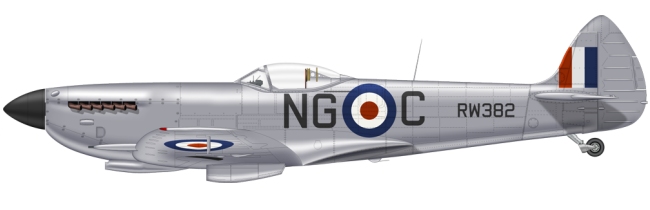
The next variant was the Spitfire Mk XVI which was powered by the 1,720-hp Packard Merlin 266 engine. This gave the aircraft a top speed of 405 mph, range of 430 miles and a service ceiling of 40,500 ft. Armament was two 20mm cannons, four 0.303-in machine-guns and 1,000lb bombs. The first Spitfire Mk XVIs began to enter service in November 1944 when No. 602 Squadron based at RAF Matlaske received the first examples.
The Spitfire Mk XVIII followed and was powered by the 2,035-hp Rolls-Royce Griffon 65 engine. Its top speed was 437 mph, range 460 miles with a service ceiling of 41,000 ft. Armament consisted of two 20mm cannons, two 0.303-in machine-guns and either 1,500lb bombs or rocket projectiles

The next variant was the Spitfire Mk XIX, this was powered by the 2,035-hp Rolls-Royce Griffon 66 engine, giving the aircraft a top speed of 445 mph, a range of 1,500 miles and a service ceiling of 42,600 ft. No armament was installed.
The next version was the Spitfire Mk 21, with the first production example flying on the 15th March 1944. Powered by the 2,050-hp Rolls-Royce Griffon 61 engine, it had a top speed of 455 mph, range of 580 miles with a service ceiling of 42,800 ft. Armament consisted of four 20mm cannons.
The Spitfire Mk 22 was the next variant and its 2,050-hp Rolls-Royce Griffon 85 engine gave it a top speed of 449 mph, a range of 580 miles and a service ceiling of 45,500 ft. Armament was four 20mm cannons and either 1,500lb bombs or rocket projectiles.
With the development of a new wing, with the plan to use a Spitfire Mk 22 as the basis for the Spitfire Mk 23, aimed at improving diving and high speed performance, fitted to a Spitfire Mk VIII in July 1944 testing began. The results from these were disappointing, so a Spitfire Mk 21 prototype would form the basis of a new Spitfire Mk 23 prototype. Once again the results were unsatisfactory, so the aircraft, which was to have been called the Supermarine Valiant, was scrapped.
The Spitfire Mk 24 would be the final variant. Powered by the 2,050-hp Rolls-Royce Griffon 61 engine, its top speed was 454 mph, range 965 miles with a service ceiling of 43,000 ft. Armament consisted of four 20mm cannons and either 1,500lb bombs or rocket projectiles.

A two-seater Spitfire was considered as a possible aircraft for the export market and during 1944 a small team was formed to convert the design into a two-seater configuration. Despite planning to build 48 aircraft, which would be designated Spitfire T.Mk VIII, only a sole example was built. Some of the Spitfires supplied to the Soviet Union were modified into two-seaters during the Second World War. These were to train Soviet pilots on the type. In January 1946 Supermarine converted 25 Spitfire Mk IXs, designated either Spitfire TR 9 or Spitfire T Mk IX, into two-seaters and these would be sold to the Netherlands, India, Ireland and Egypt.
The idea of a naval version of the Spitfire was first raised in 1938, but it wouldn't be until December 1941 that the idea was looked at again. This would lead to the Supermarine Seafire being developed for the Fleet Air Arm. A Spitfire floatplane was also produced, five Spitfires would be modified and fitted with floats before the idea was scrapped.
The fighter version made its last operation on the 1st January 1951 when a Spitfire Mk XVIII of No. 60 Squadron attacked targets in Malaya. The very last operational use of the Spitfire was on the 1st April 1954 by a Spitfire PR XIX of No. 81 Squadron based at RAF Seletar, with a civilian operated Spitfire Mk XIX of the RAF Temperature and Humidity Flight at RAF Woodvale performing the last flight by an RAF Spitfire in active service on the 10th June 1957. During 1963 a Spitfire PR Mk XIX would be brought out of retirement to take part in trials against the English Electric Lightning. This was so tactics against piston-engined aircraft could be developed as there was a chance the Lightning may come up against the North American P-51 Mustangs being used by the Indonesian Air Force during the Indonesia – Malaysian Confrontation (1963 – 1966).
In total over 30 countries would use the Spitfire in various guises. They would see action with the Soviet Union on the Eastern Front and the United States Army Air Force and Free French Air Force would also use the aircraft. Post-war saw the type serve with the Swedish Air Force.
The last Spitfire to be built was a Spitfire F.24, and this made its first flight on the 24th February 1948, bringing an end to Spitfire production which had began in May 1938 and saw a total of 20,334 built. It was the only Allied fighter already in production at the start of the Second World War to remain in production throughout the war.

| Top Speed | Range | Service Ceiling | Armament | ||
|---|---|---|---|---|---|
| Spitfire Mk I | 364 mph | 425 miles | 34,500 ft | eight 0.303-in machine-guns | 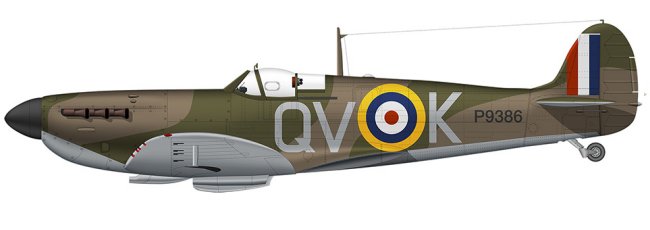 |
| Spitfire Mk II | 370 mph | 500 miles | 32,800 ft | eight 0.303-in machine-guns | 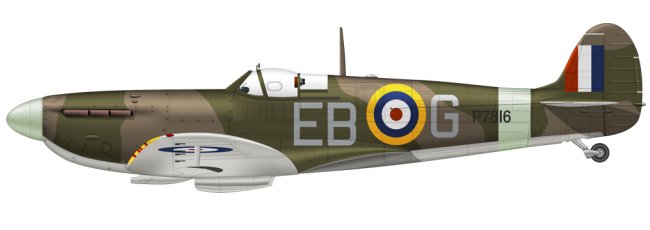 |
| Spitfire Mk III | Single aircraft converted from a Spitfire Mk I then converted to a Spitfire Mk V then to the Spitfire Mk IX prototype. | ||||
| Spitfire Mk V | 375 mph | 470 miles | 35,500 ft | two 20mm cannons four 0.303-in machine-guns |
 |
| Spitfire Mk IV | Powered by the 1,445-hp Rolls-Royce Griffon RG 25M IIB engine, only one built. Renamed later on as Mk XX before becoming the Mk XII prototype |
||||
| Spitfire Mk VI | 364 mph | 475 miles | 40,000 ft | two 20mm cannons four 0.303-in machine-guns |
|
| Spitfire Mk VII | 416 mph | 424 miles | 45,100 ft | two 20mm cannons four 0.303-in machine-guns |
|
| Spitfire Mk VIII | 408 mph | 680 miles | 43,000 ft | two 20mm cannons four 0.303-in machine-guns |
|
| Spitfire Mk IX | 408 mph | 434 miles | 43,000 ft | two 20mm cannons four 0.303-in machine-guns |
|
| Spitfire Mk X | 417 mph | 1,370 miles | 43,000 ft | none | |
| Spitfire Mk XI | 417 mph | 1,200 miles | 44,000 ft | none | 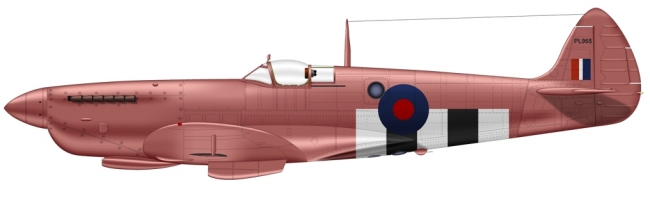 |
| Spitfire Mk XII | 397 mph | 493 miles | 40,000 ft | two 20mm cannons 500lb bombs |
|
| Spitfire Mk XIII | 342 mph | 700 miles | 35,000 ft | four 0.303-in machine-guns | |
| Spitfire Mk XIV | 439 mph | 465 miles | 43,000 ft | two 20mm cannons two 0.50-in machine-guns and either 500lb bombs or rocket projectiles |
|
| Spitfire Mk XVI | 405 mph | 430 miles | 40,500 ft | two 20mm cannons four 0.303-in machine-guns 1,000lb bombs |
 |
| Spitfire Mk XVIII | 437 mph | 460 miles | 41,000 ft | two 20mm cannons two 0.303-in machine guns and either 1,500lb bombs or rocket projectiles |
|
| Spitfire Mk XIX | 445 mph | 1,500 miles | 42,600 ft | none | |
| Spitfire Mk 21 | 455 mph | 580 miles | 42,800 ft | four 20mm cannons | 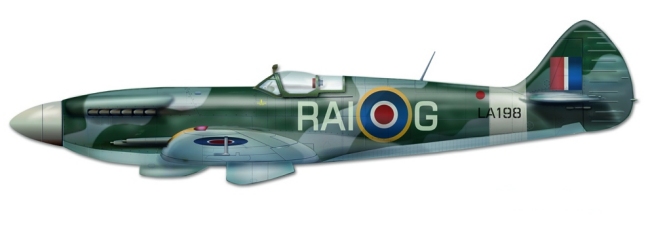 |
| Spitfire Mk 22 | 449 mph | 580 miles | 45,500 ft | four 20mm cannons and either 1,500lb bombs or rocket projectiles |
|
| Spitfire Mk 23 | None produced but would have been known as the Supermarine Valiant. | ||||
| Spitfire Mk 24 | 454 mph | 965 miles | 43,000 ft | four 20mm cannons and either 1,500lb bombs or rocket projectiles |
|
What's on Classic Warbirds |
|
|
|
|
|